Common Ground Research Networks Publishers Prize

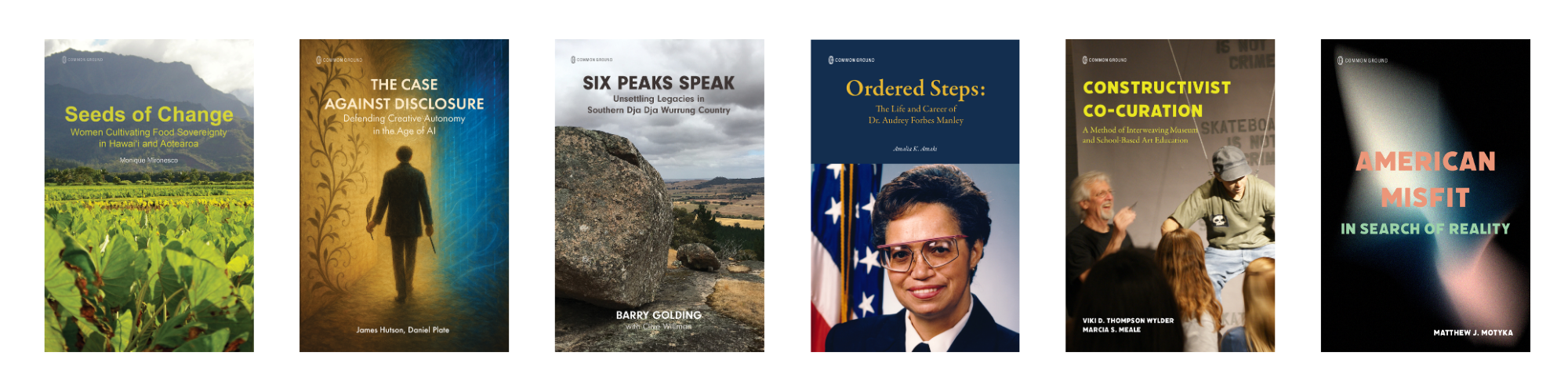
Monique Mironesco
Seeds of Change: Women Cultivating Food Sovereignty in Hawai‘i and Aotearoa is organized thematically, weaving together research from both locations to explore and compare women’s roles and leadership in alternative food networks (AFNs). At the heart of this inquiry is how women’s leadership functions as a form of resistance to industrial agro-food systems within settler colonial contexts. The book asks: How do Indigenous and marginalized women shape these resistances? How do Indigenous ecological worldviews inform both ancestral and contemporary food and agricultural practices as forms of decolonial praxis? While AFNs are often framed as solutions to the failures of industrial food systems, they have also been critiqued for reinforcing elitism and exclusion. This study foregrounds how Indigenous women confront not only the violence of industrial agriculture but also inequities within AFNs themselves. Though situated in distinct political, social, and ecological contexts, the strategies of women in Hawai‘i and Aotearoa offer transferable insights and best practices for other island communities and beyond. The book is structured around three central themes: women’s leadership in AFNs; the amplification of Indigenous and marginalized voices; and a solution-oriented approach that shares lessons across Oceania. Based on interviews with 48 women—including farmers, union leaders, composters, market organizers, and educators—the research reflects a wide spectrum of food system actors embedded in nonprofit and grassroots networks. A core aim of the book is to generate an actionable toolkit and to ensure that the knowledge shared through these stories supports broader movements for food sovereignty and ecological justice.
James Hutson and Daniel Plate
The Case Against Disclosure: Defending Creative Autonomy in the Age of AI challenges the prevailing assumption that creators must disclose their methods when using artificial intelligence. As AI tools become deeply embedded in writing, research, coding, and artistic production, institutions, publishers, and the U.S. Copyright Office have moved toward transparency mandates, requiring creators to document and reveal the extent of AI assistance in their work. This book argues that such demands are neither ethically justified nor practically enforceable, representing an unnecessary and damaging encroachment on the creative process. Transparency, often framed as a safeguard for authenticity and accountability, is instead an instrument of control—one that reinforces outdated notions of originality while failing to account for the realities of AI-driven authorship. The Case Against Disclosure dismantles the myth that process defines authorship, asserting that credibility stems from the willingness to take responsibility for a work, not from exhaustive documentation of how it was made. Through legal analysis, historical parallels, and contemporary case studies, this book exposes how transparency mandates create unnecessary barriers, restricting creative autonomy and imposing impractical bureaucratic oversight on the production of knowledge and culture. Essential reading for scholars, policymakers, and professionals in media, law, and technology, this work presents a forceful argument against institutional overreach, advocating for a future in which creators retain full control over their methods. It is both a scholarly intervention and a polemic, making the case that the right to opaque creation is fundamental to intellectual and artistic freedom in the AI age.
Barry Golding with Clive Willman
Mountains can tell us much about our past. Six iconic peaks in Central Victoria, Australia, Mounts Kooroocheang, Beckworth, Greenock, Tarrengower, Alexander, and Franklin, tower above the rich volcanic grasslands. Each has borne witness to dramatic changes in Dja Dja Wurrung Country over the past two centuries. "Six Peaks Speak" tells the unique stories and continuing legacies of these mountains from a multidisciplinary perspective. Created as part of Barry Golding’s State Library Victoria Creative Fellowship in 2023, it accesses seldom-visited archives, turning the idea of ‘settling’ on its head, instead using ‘unsettling’ as its fundamental organizing principle. The book threads insights and evidence from diverse historical sources, including First Nations, geological, ecological, community, and reserve management. The peak-specific stories illustrate how many ‘taken for granted’ aspects of mountains may not be as they seem. This timely book raises questions about the extent to which mountain peaks and their surrounding reserves have been managed in the public interest. In the process, it seeks to answer the broader question, ‘How can we help future generations deal with the unsettling legacies of what has happened to mountains?’ It makes reference in its conclusion to the origins of International Mountain Day in the US, in the same era as these peaks were being unsettled in Australia in 1838. Aside from what it reveals about the six peaks, the book showcases ideas and methodologies for creatively reconnecting with and healing other mountains and the people who today live on their flanks, and on Country in between.
Amalia Amaki
Viki Thompson Wylder and Marcia Meale
Constructivist Co-Curation: A Method of Interweaving Museum and School-Based Art Education tells a unique story through a retrospective case study of the curatorial convergence of museum educators, utilizing their theory and programs, with art educators, utilizing their theory and pedagogy. The book describes a method that advances museum and school-based practice by asking art teachers to develop projects and curate exhibitions with museum educators. Inherent is the diminishment of unintentional barriers between school and museum systems as school and museum educators strive for mutual conceptualization and purpose. The method nurtures usage of museums and increased meaning-making within them by the school system audience (teachers, students, and families). School programs expand and deepen through increased and more easily accessed museum-based resources (original artworks, artist interactions, exhibitions, and museum materials and activities). This book presents Constructivist Co-Curation as a “cutting edge” model and includes a “how-to-do-it” guide.
Matthew Motyka
American Misfit: In Search of Reality interweaves personal experience with key historical events from the past half-century, showing how they shape individual consciousness. Grounded in Paul Ricoeur’s theory of narrative—which sees storytelling as essential to understanding our world—Matthew Motyka recounts his multicultural journey. Raised in communist Poland, he spent his twenties in France before moving to the United States. Though he thrives as an immigrant, he confronts a lingering question: Why does America, generous to outsiders, resist being fully loved?
In search of answers, Motyka turns to European intellectuals such as Simone Weil, Leszek Kołakowski, Tzvetan Todorov, and Alain Finkielkraut, whose reflections on uprootedness, immigration, and alienation illuminate his own experience. This juxtaposition of personal story and historical context reveals the profound influence of global events on individual identity—and the difficulty of ever fully belonging to one’s adopted home.
Kim Thu Le
Culture of Crisis and Extinction: Idealism and Ideology Expressed in Arts and Architectural Forms explores the mythology of cultures in crisis, tracing the symptoms that lead to their destruction and eventual extinction. Through a comprehensive range of research methods and strategies tailored to each fieldwork project, this book investigates cultural phenomena across various environments. It uncovers significant historical meanings that are often hidden or absent from mainstream publications
2024 Finalists:
Nurit Elhanan-Peled
The Zionist pedagogical narrative reproduced in schoolbooks views the migration of Jews to Israel as the felicitous conclusion of the journey from the Holocaust to the Resurrection. It negates all forms of diasporic Jewish life and culture and ignores the history of Palestine during the 2000-year-long Jewish “exile.” This narrative otherizes three main groups vis-à-vis whom Israeliness is constituted: Holocaust victims, who are presented in a traumatizing manner as the stateless and therefore persecuted Jews “we” refuse but might become again if “we” lose control over Palestinian Arabs, who constitute the second group of “others.” Palestinians are racialized, demonized, and portrayed as “our” potential exterminators. The third group of “others” comprises non-European (Mizrahi and Ethiopian) Jews. They are described as backward people who lack history or culture and must undergo constant acculturation to fit into Israel’s “Western” society. Thus, a rhetoric of victimhood and power evolves, and a nationalistic interpretation of the “never again” imperative is inculcated, justifying the Occupation and oppression of Palestinians and the marginalization of non-European Jews. This rhetoric is conveyed multimodally through discourse, genres, and visual elements. The present study, which advocates a multidirectional memory, proposes an alternative Hebrew-Arabic, multi-voiced and poly-centered curriculum that would relate the accounts of the people whom the pedagogic narrative seeks to conceal and exclude. This joint curriculum will differ from the present one not only in content but also ideologically and semiotically. Instead of traumatizing and urging vengeance, it will encourage discussion and celebrate diversity and hybridity.
2023 Finalists:
Conor Heffernan
Physical culture can be crudely defined as those exercise practices designed to physically change the body. In modern parlance we may associate physical culture with weightlifting, physical education, and/or calisthenics of various kinds. While the modern age has experienced an explosion of interest in gym-based activities, the practice of training one’s body has a much longer, and fascinating, history. This book provides an engaged and accessible historical overview from the Ancient World to the Modern Day. In it, readers are introduced to the training practices of Ancient Greece, India, and China among other areas. From there, the book explores the evolution of exercise systems and messages in the Western World with reference to three distinct epochs: the Middles Ages and Renaissance, the Enlightenment, and its aftermath and the nineteenth to the present day. Throughout the book, attention is drawn not only to how societies exercised, but why they did so. The purpose of this book is to provide those new to the field of physical culture an historical overview of some of the major trends and developments in exercise practices. More than that, the book challenges readers to reflect on the numerous meanings attached to the body and its training. As is discussed, physical culture was linked to military, religious, educational, aesthetic, and gendered messages. The training of the body, across millennia, was always about much more than muscularity or strength. Here both the exercise systems, and their meanings are studied.
2022 Finalists:
Jörg Krieger, April Henning, Lindsay Pieper, and Paul Dimeo
In the edited collection "Time Out: Global Perspectives on Sport and the Covid-19 Lockdown," practitioners and international scholars explore the impact of the global Covid-19 health pandemic on sport from a global perspective. It is part of a two-volume Covid-19 and Sport series that tackles the effects of the global lockdown on sport during March and April 2020, when restrictions were at their most severe and the human toll at its peak in many countries. The chapters provide a comprehensive overview of the immediate consequences of the Covid-19 lockdown on sport. This book presents a variety of interdisciplinary perspectives in a total of twenty individual chapters, organized around three main themes. The first section explores the reactions of international stakeholders within the global sport system to the pandemic. In section two, the authors focus on the impact of the Covid-19 crisis on sporting participants within an international context, including effects on both elite athletes and leisure sport participants. The final section includes the impacts on and reactions of individual sports.
2021 Finalists:
Patricia Reinheimer
Olly emerged in the artistic field in the 1950s. She amassed positive reviews about her production. However, in the artistic universe, claiming quality is not enough. It was necessary that her work dialogued with some of that universe’s significant proposals: they had to make sense. What was that sense? Recognized while producing, but forgotten after her death, it is to Olly’s trajectory the author seeks to assign meaning. "Olly: Race, Class, and Gender in the Invention of Rustic Modernity" is a tribute to the author’s grandparents and a critique of the attitude of much of the white Brazilian middle-class towards peripheric groups. Looking at the artist’s subjects, the author identifies in her web of relations the creation of the idea of a "sensibility" that was intended to be universal, but even though it was based on different peripheric groups, it was produced and consumed by a certain white middle-class audience..
2020 Finalists:
Richard A. Nissenbaum, Joseph E. B. Elliott
"In Exchange for Gold: The Legacy and Sustainability of Artisanal Gold Mining in Las Juntas de Abangares, Costa Rica" documents the linkage between human experience and ecology. Richard A. Nissenbaum and Joseph E. B. Elliott render a nuanced understanding of the complex issues involved in developing sustainable approaches to protecting the environment and how those approaches might also respect the communities and individuals inextricably tied to gold. Highlighting the personal, this case study honors a community, its rich culture, and history, while simultaneously examining the environmental and human cost of gold extraction.
2019 Finalists: