End-of-Life Decision-Making in East Asia: Legal Challenges, Cultural Norms, and Advance Planning
March 9, 2025 - 9:00AM CST USA
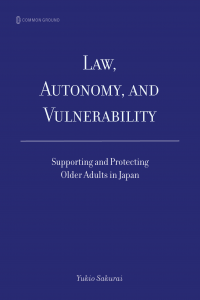
Law, Autonomy and Vulnerability explores how adult support and protection legislation can integrate adult guardianship, supported decision-making, and elder abuse prevention, particularly in light of the limitations of Japan’s current guardianship system. It develops the concept of legal advocacy for vulnerable adults at the intersection of civil and social security law, grounded in two frameworks: the vulnerability–autonomy approach from common law traditions and a comparative legal analysis of Japan and Australia. The central question asks how legal and policy frameworks can respect individual will while ensuring effective, community-based implementation.
The analysis unfolds in three parts. First, it conceptualizes adult support and protection legislation as a rights-based framework that prioritizes individualized support through the least restrictive means. Second, it examines institutional safeguards and evolving norms around supported decision-making, including soft-law developments and legislative models such as Australia’s. Third, it proposes a community-based support model, led by quasi-public core agencies that coordinate with courts, municipalities, and local networks.
Three main contributions emerge: (1) a normative foundation for adult support legislation in Japan, (2) an analysis of Victoria’s Guardianship and Administration Act 2019 as a case of integrating empirical research and stakeholder input, and (3) an operational model for community-based adult protection. A legislative roadmap for Japan is presented, showing how supported decision-making can be incrementally codified, with guardianship reserved as a last resort. The study concludes by identifying future research needs, particularly regarding safeguards and comparative models of advocacy.
Read for free as a part of Common Ground Research Network's Open Access Program!